

Dambulla
Dambulla Cave Temple, also known as the Golden Temple of Dambulla, is a breathtaking UNESCO World Heritage site that has served as a sanctuary for over 22 centuries. Legend has it that King Valagamba sought refuge here in the 1st century BC, and in gratitude, he transformed these massive granite caves into a magnificent place of worship. Rising 160 metres above the surrounding plains, the temple complex is a masterpiece of religious devotion, where nature and human creativity merge into one.
Book This Tour →Traditional Value, Preserved for 22 Centuries
The ceilings and walls of the five caves are covered in over 2,100 square metres of intricate murals. What makes them truly “Paramparika” (traditional) is the use of natural pigments — vegetable dyes and minerals — that have retained their vibrant reds, yellows and golds for centuries, depicting the life of the Buddha with artistic detail unparalleled in Asia. Inside, 153 Buddha statues of varying sizes await, including a 14-metre reclining Buddha carved directly into the living rock, spanning eras from the early Anuradhapura period to the late Kandyan kingdom.
“A place where silence speaks, and every mural tells a story of an ancient, resilient civilization.” Central Province, Sri Lanka
Getting There


A Living Canvas of Faith
For anyone drawn to art and craftsmanship, Dambulla’s caves are a masterclass spanning centuries.
Painted in natural vegetable dyes and minerals, the murals have kept their vibrant reds, yellows and golds for centuries, depicting the life of the Buddha with unmatched artistic detail.
From a 14-metre reclining Buddha carved into the living rock to smaller figures from the Kandyan era, the caves trace the evolution of Sri Lankan sculpture.
A Sanctuary of 22 Centuries
Dambulla has served as an active place of worship since King Valagamba’s time.
Legend holds that King Valagamba took shelter here in the 1st century BC, later transforming the caves into a temple in gratitude.
In the largest cave, water seemingly flows upward against gravity before falling into a golden vessel — considered sacred and still used in temple rituals today.
Activities & Nearby Attractions
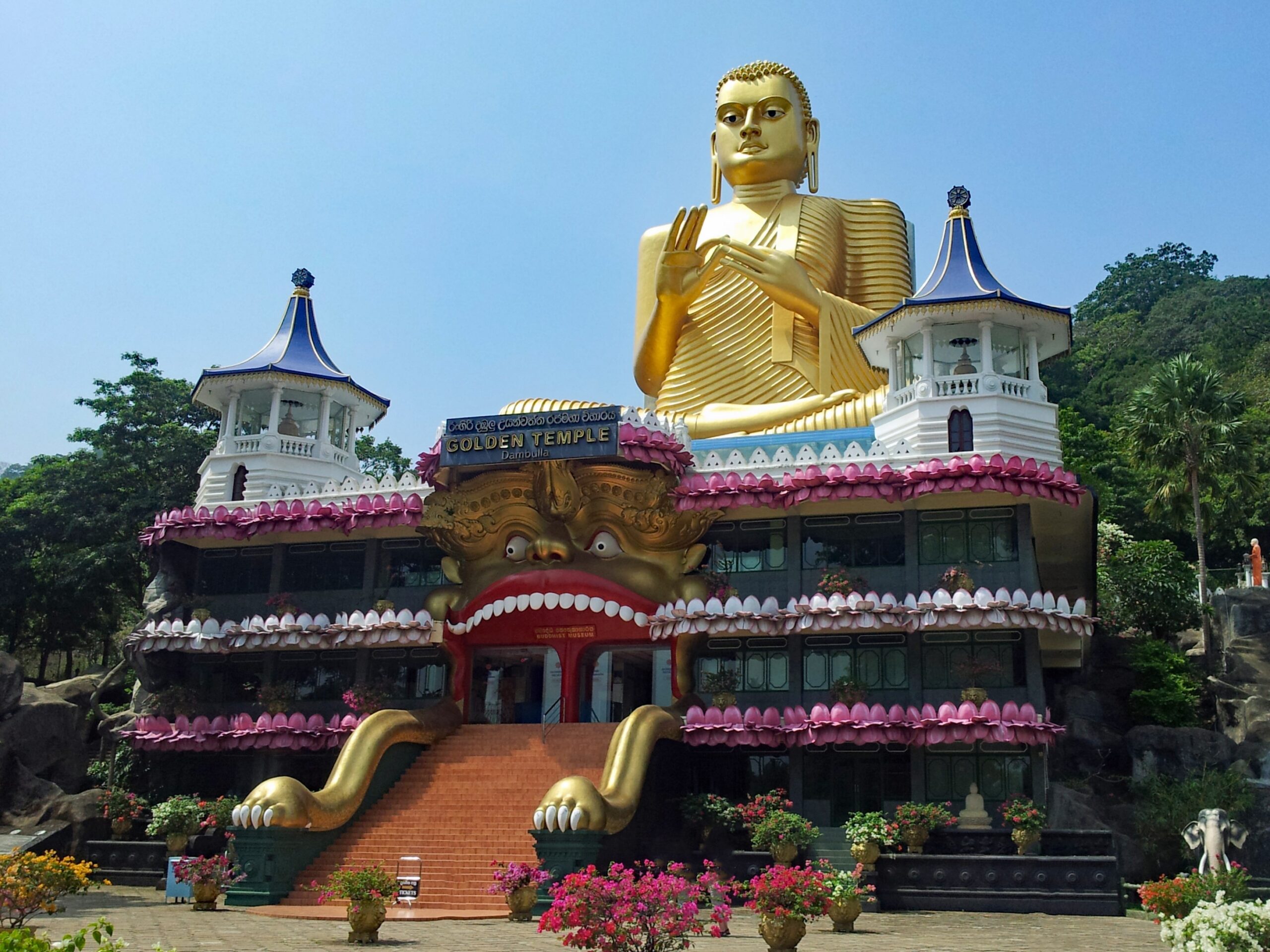
At the base of the rock, the colossal Golden Buddha statue and adjoining museum offer a modern tribute to the ancient heritage above.
The climb to the caves offers one of the Cultural Triangle’s best viewpoints, with Sigiriya Rock visible in the distance on a clear day.
Nearby, this ancient forest sanctuary holds the largest pink quartz mountain in South Asia — a peaceful retreat off the typical tourist trail.
Two moments to remember
Seeing the centuries-old pigments glow under the soft light of an early visit is one of Dambulla’s quietest, most striking moments.
Spotting the distant silhouette of Sigiriya Rock rising from the jungle canopy from Dambulla’s viewpoint connects two of the Cultural Triangle’s icons in a single glance.
Things you’ll do
Ascend the rock at a comfortable pace, ideally in the cooler morning hours between 7:30 and 9:00am.
Take your time through each cave’s murals and statues, allowing two to three hours for an unhurried visit.
See the modern Golden Buddha and museum at the base of the rock before or after the climb.
Best Times to Visit, Weather & Practical Wisdom
When to visit, what to wear, and how long to plan for.
The Morning Glow
Start your ascent between 7:30am and 9:00am. The morning sun illuminates the golden facade of the temple, and the cool, fresh air makes the climb much more enjoyable.
The Season of Light
While accessible year-round, January to May offers the clearest skies and most comfortable walking conditions for exploring the cave temples.
Climate & Dress Code
The region is warm, ranging from 28°C to 33°C. Wear modest clothing covering shoulders and knees as a sign of respect for this sacred site.
Three reasons Dambulla stands apart.
22 Centuries of Sacred Use
Dambulla Cave Temple has served as a place of worship and refuge since the 1st century BC, making it one of Sri Lanka’s longest continuously used sites.
150+ Buddha Statues, 2,100m² of Murals
The scale and preservation of Dambulla’s painted ceilings and statues make it a UNESCO World Heritage Site without equal in the region.
Gateway to the Cultural Triangle
Dambulla pairs perfectly with Sigiriya and Polonnaruwa as part of a Cultural Triangle loop — an easy overnight stay covers all three unhurried.
“Dambulla is the perfect spiritual gateway to the Cultural Triangle — explore it slowly, and let every detail speak.”
With Fly By Travels, your journey to this sacred mountain is as serene as the temple itself. Our luxury vehicles provide the comfort you need to relax before and after your climb, with expert drivers who navigate the region with total ease and safety.